How to hire an AI consultant: a 12-question checklist
A step-by-step guide: what to ask, how to verify cases, which red flags you shouldn't ignore. From a consultant who often turns clients away at discovery.
Andrew Maryasov, founder of Auspex and Grow2.ai, wrote this guide after 28 AI projects and dozens of discovery sessions with businesses of every size. This is the very checklist clients receive after the first call.
To be straight about the framing: I am one of the people you would assess with this checklist. I pass some of the questions below and fail others; where that happens, I say so in the text.
What an AI consultant is (and how it differs from an agency)
An AI consultant is a person (less often a team) who helps a business:
- Find the processes worth (and not worth) automating with AI.
- Design a solution for the specific business context.
- Launch a pilot, measure ROI, and decide on scaling.
This is not the same as:
- An AI agency — sells delivery (often without discovery). Takes on volume.
- A trainer — teaches the team but does not implement.
- An AI developer — writes code against a finished spec.
A good AI consultant often persuades the client not to implement AI where a decent CRM or a script is enough.
12 questions to ask before hiring
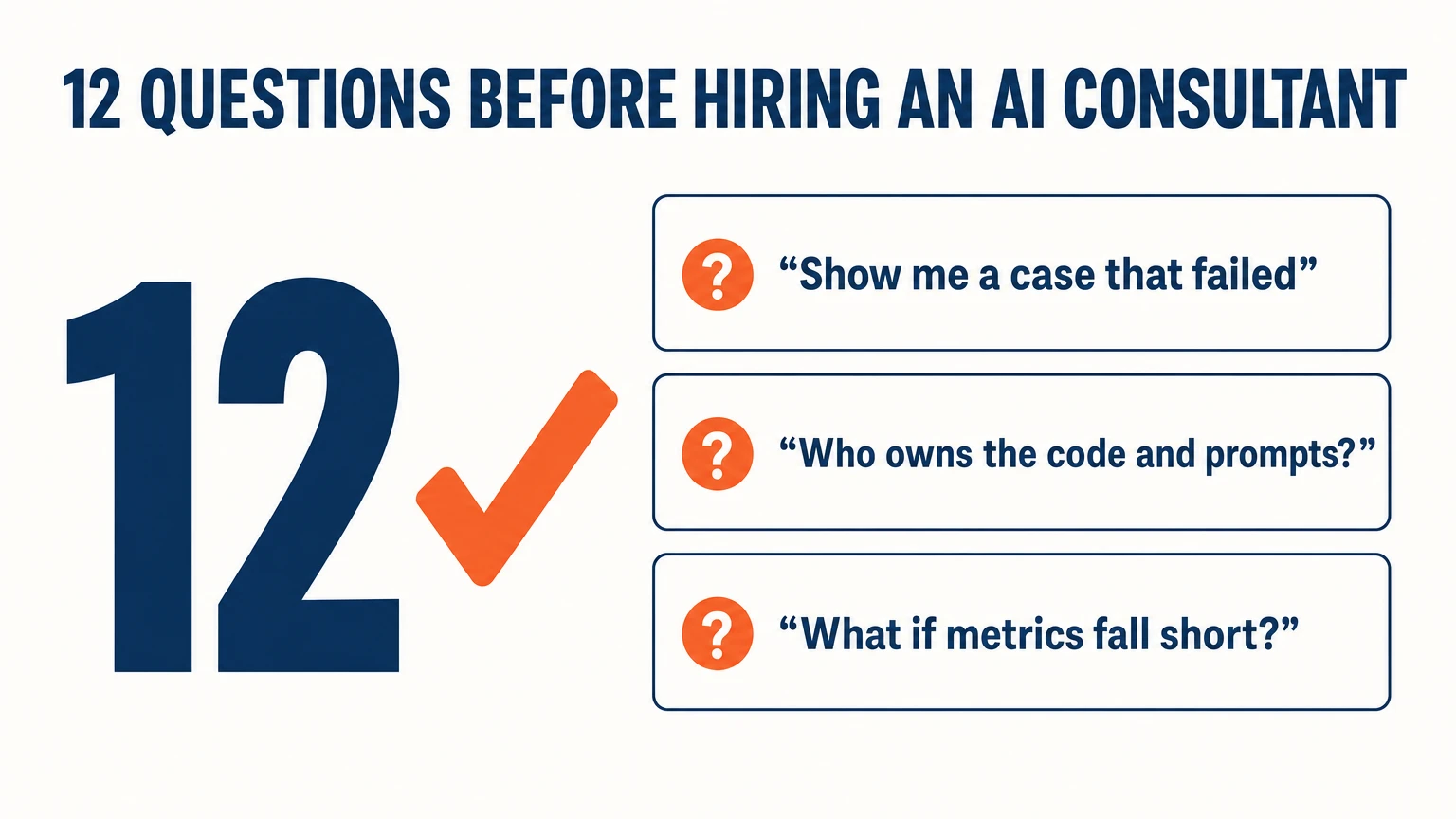
1. “Show me a case that failed”
If a consultant says “everything we do works” — that’s a red flag. In my experience, plenty of SMB AI projects never take off. If a person can’t name their failure, they’re either a beginner or dishonest.
A good answer sounds roughly like this (an illustration; the figures are made up):
“In 2024 we built an AI agent for a distributor’s B2B support. Accuracy in tests was 89%, in production it dropped to 71% — clients wrote in slang and abbreviations. We rolled back, rebuilt the RAG with domain-specific embeddings, and accuracy rose to 93%. But during discovery I underestimated the complexity of the domain language — that was my mistake.”
2. “Who owns the code and prompts after the project?”
The canonical answer: you, the client. Everything. If a consultant offers “we maintain the infrastructure on our side” without handover — that’s vendor lock-in. In 12 months you’ll be a hostage.
3. “How much discovery time before the first commit to code?”
If it’s less than 2 weeks, they most likely cut the analysis. In our projects discovery takes 30–40% of the whole scope — that is my own observation from our implementations, not an industry norm.
4. “How do you measure accuracy?”
Red flag: “we test manually on 20 queries.”
The right way: regression tests on 200+ real dialogues that run on every prompt update. Without this, accuracy degrades silently.
5. “What do you do about hallucinations?”
The expected answer is three levels:
- A supervisor agent checks facts against the knowledge base.
- A system prompt: “if you don’t know, hand off to a human.”
- Regression tests after every change.
If you hear “we use the best model and there are almost no hallucinations” — this person has never run AI in production.
6. “What’s the minimum contract?”
If a consultant is ready to come in for 1 week — that’s a warning sign. A pilot for an AI agent is a minimum of 2–3 weeks. Standard is 6–10 weeks.
7. “What happens if the metrics don’t reach what was promised?”
The contract should have a concrete clause. For example: “If 30 days after launch the metric is < 50% of the target value, we refund 50% of the payment or do a free iteration.”
8. “Which CRMs/integrations have you done?”
If you have Bitrix24 or 1С, the question is critical. Most “AI consultants” from the US and EU have never touched these systems. Look for someone with regional experience.
9. “Who’s behind you?”
A solo consultant is fine if they have a transparent portfolio. But ask about backup: what happens if the person falls ill in the middle of the project?
10. “Show me an architecture diagram of one project”
A good consultant will sketch the boxes and arrows in 2 minutes. If a person starts with “it depends” — dig deeper.
11. “Which stack do you use and why?”
Red flag: “we use the newest technology” (the person picks what is fashionable, not what fits the job).
A good answer: “In most cases — a current-generation Claude model, pgvector and n8n. It’s a mature stack. If a project needs real-time or on-premise, we switch. I don’t like changing the stack for the sake of novelty.”
12. “How do you handle NDAs and confidentiality?”
Canonically: the NDA is signed before discovery, data is processed in EU regions, and there’s an on-premise option for critical cases.
How much an AI consultant costs
I know of no verified source for “market ranges”, so I am not quoting any: a made-up number calibrates you worse than no number at all. What I can give you is the public price list of the teams that run my delivery, so you have something to compare other offers against.
| Grow2.ai plan | Scenario | Price |
|---|---|---|
| Starter | One agent, one channel, one CRM; 14-day pilot | €1,800, then from €49/mo + tokens |
| Practice | Two agents, multichannel, CRM hygiene; 21-day pilot | €3,600, then from €99/mo + tokens |
| Operator | All modules, voice, multilingual; 30-day pilot | from €6,000, then from €149/mo + tokens |
The pilot is paid up front, and if the agreed metric has not moved at the day-30 review, the full amount is returned. Current terms are on the pricing page. If someone offers “an AI agent for $500 turnkey” — that’s a templated chatbot, not consulting.
Red flags
- Can’t name concrete figures from past cases.
- Doesn’t show the architecture.
- Says “AI will solve everything” (a good consultant often turns you down).
- Doesn’t ask about metrics during discovery.
- Works without an NDA.
- Won’t explain what the up-front money buys. Prepayment on its own is not the problem: our own pilot is paid up front, but with a full refund if the metric has not moved at the day-30 review. The problem is prepayment with no obligation on the other side.
- Refuses to put success criteria in the contract.
What an ideal discovery call looks like
30–60 minutes. The consultant asks you:
- “Which 3 processes take up the most of the team’s time?”
- “How much does an hour of work cost for the specialist who handles these processes?”
- “What have you already tried, and why didn’t it take off?”
- “What budget are you ready to allocate for a pilot?”
- “What result, in numbers, would you call a success after 90 days?”
If a consultant sells during discovery instead of listening — that’s not a consultant, that’s a salesperson.
Who I am to be advising you
Andrew Maryasov is an AI practitioner, founder of Auspex (CRM) and Grow2.ai (AI agents). 28 AI projects across 14 industries and 7 countries, 25+ years in business automation. He often turns down prospective clients during discovery — recommending they set up their CRM properly first.
FAQ
How much does it cost to hire an AI consultant in Ukraine?
I run the discovery session for free, it takes thirty minutes. After that it depends on scope. The one benchmark I can back with a document: a Grow2.ai agent pilot costs €1,800 (14 days), €3,600 (21 days) or from €6,000 (30 days), then a subscription from €49/mo plus tokens — pricing. Strategic consulting is separate: my formats are at /en/advisory/.
Do I need an AI consultant if I don’t have a technical team?
Yes — that’s an even better scenario. The consultant designs the solution so your operations team can use it without developers. Knowledge transfer is included in the project.
How do I know an AI consultant isn’t a fraud?
Check 5 things: 1) Cases with figures; client contacts where the client allowed it (some of our cases are anonymous by agreement, and that is fine as long as the figures can be checked), 2) Architecture diagrams, 3) An NDA before discovery, 4) Success criteria locked into the contract, 5) Willingness to turn you down if AI won’t deliver ROI.
How long does a typical AI project take?
Pilot — 2–3 weeks. Standard — 6–10 weeks. Enterprise — 3–6 months.
Can I hire an AI consultant at an hourly rate?
You can — for small tasks (an audit, training the team). For implementing an agent it’s better to use fixed-price with clearly defined deliverables.
See also
- AI consulting in Ukraine: when you need it and where to start — how my own practice works, in case this checklist is what you’ll evaluate me with.
- Seven questions for an AI agent development company — for when you’re hiring a builder rather than an adviser.

A letter on AI — 2–3 emails a month
Personal essays on how AI changes the way we think and work: what I tried myself, what worked and what didn't. At the end, links to the best of what I read.
No spam. Unsubscribe in one click.