AI consulting in Ukraine: when you need it and where to start
A personal service page: how I work with business owners, who needs an AI consultant, who is still too early, and three conditions worth demanding from any vendor.
Andrew Maryasov — AI consultant, founder of Auspex (CRM implementation) and Grow2.ai (AI agents, the AI division of Auspex). 25+ years in business automation: accounting → CRM → AI. I build strategy personally with owners and their teams; implementation is run by the brands’ teams.
Conflict of interest up front: I am one of the consultants you would be evaluating. This page describes my own model of working, and where it doesn’t fit you, I’ll say so at discovery rather than after signing.
Who I am and how I work
I don’t sell hours and I don’t run projects hands-on. My part is working out where AI gives your process leverage and where it only adds noise, then writing the brief the implementation team builds from.
Over the last three years: 28 AI projects across 14 industries and 7 countries, and eight of my own AI systems running in daily production. Plus my own operating system — seventeen agents on a Mac mini that I live with every day. That’s what taught me the thing I bring to every discovery call: the bill for AI is made of the time a human spends checking the model’s output, not of the model itself. Whoever leaves that out of the budget is surprised by the invoice later.
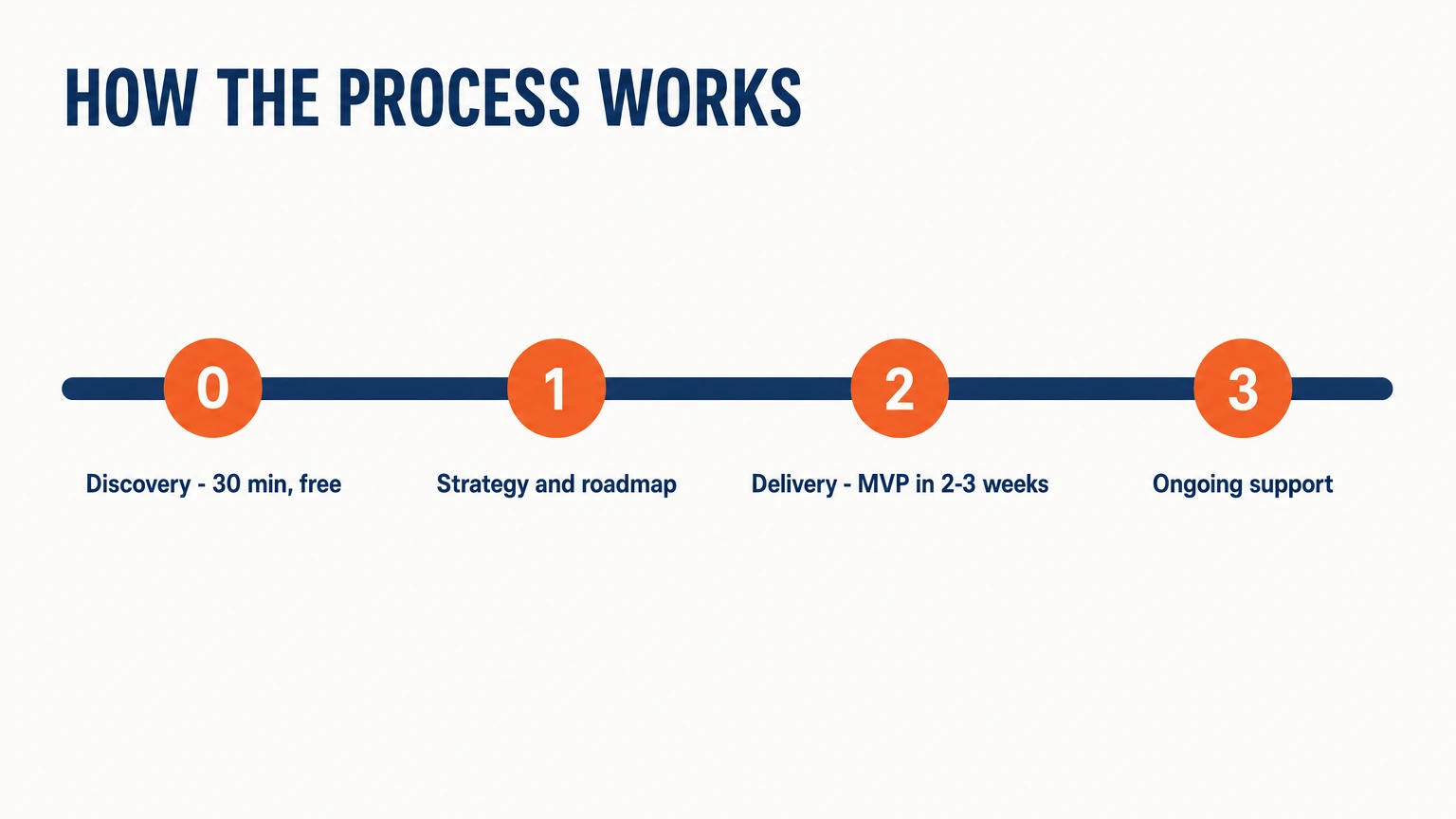
The route is simple: a free 30-minute discovery → strategy and roadmap with me personally → implementation at Auspex (CRM and processes) or Grow2.ai (AI agents) → support from the same team. The ways to work with me are on the advisory page.
Who needs this, and who is still too early
A consultant pays for himself if you have a company of 10–200 people, a CRM of some kind, an internal person able to give the project 8–12 hours a week, and three metrics you’ll judge success by.
If there’s no CRM, or it’s a mess, the place to start is order in the CRM. That isn’t a polite refusal: an agent reading bad data simply reaches bad conclusions faster. At our price list an agent starts paying off from roughly two hundred enquiries a month; between fifty and two hundred it’s cheaper to fix the process first.
What it looks like when it does add up
Two examples from Grow2.ai practice. A manufacturer with a network of 500 dealers: two managers were the human interface to the accounting system, and that routine cost ≈700K UAH a year (≈$17K). A read-only agent cost ≈110K UAH (≈$2.7K) to build and ≈18K UAH (≈$440) a year to run; the net first-year effect was ≈572K UAH (≈$14K), paying back in 2–3 months. People laid off: zero.
The second is a large Ukrainian clothing retailer with a network of 30+ physical stores; the name stays undisclosed by agreement. A consultant agent works in Instagram, Viber, Telegram and the site chat: 6,448 conversations from April to July 2026, a median response of 13 seconds, model costs of ≈€0.10 (≈$0.11) per conversation. A human manager still places the final order.
Three conditions worth demanding from any vendor
- The NDA is signed before discovery, not after. If you’re asked to explain everything first and sign later, that’s already an answer about how other people’s data is handled here.
- Code ownership. Everything built on the project belongs to you: code, prompts, architecture, documentation. Not “access while you keep paying”.
- Willingness to say no. A vendor who never turns work down is selling you their hours rather than a solution.
The longer version is a twelve-question checklist for hiring a consultant. If you’re choosing an implementation company, Grow2.ai has a breakdown of seven questions to ask a development shop and a general overview of AI consulting for small business.
What it costs
I don’t duplicate prices here, so they can’t drift out of sync with reality. Fixed-fee agent pilots with a money-back guarantee are on the Grow2.ai price list. CRM audit and implementation are quoted by Auspex after an audit; the audit itself takes 2–3 days. The ways to work with me personally are on the advisory page.
FAQ
How is AI consulting different from AI development?
Consulting comes before development: discovery, architecture, a payback estimate. A consultant can advise against launching AI at all when the numbers don’t add up.
Do you do the implementation yourself?
No. I build the strategy and the architecture; the teams implement — Auspex for CRM and processes, Grow2.ai for AI agents. If you already have a technical team, I come in only as an architect.
Do you work with Bitrix24, Uspacy, 1C?
CRM is Auspex territory: Uspacy, monday.com, Pipedrive, Zoho, Bitrix24. Bitrix24 has been unavailable in Ukraine since 1 June 2023, so new portals go on Uspacy while existing ones are supported; in EU markets we implement Bitrix24 as a Gold Partner. 1C and BAS are handled selectively, through integration wrappers.
What if we already work with another agency?
I can come in as a second opinion, or take one module of the strategy. I don’t claim to be your only vendor.
Next
A free 30-minute discovery call — you tell me what hurts, I tell you whether there’s an AI task here at all. If there isn’t, I’ll say that too.

A letter on AI — 2–3 emails a month
Personal essays on how AI changes the way we think and work: what I tried myself, what worked and what didn't. At the end, links to the best of what I read.
No spam. Unsubscribe in one click.