Which Automations to Implement First: 5 Steps in Order
Not the flashiest ones, but the ones that give a measurable result in two weeks. Five automations in the order to implement them, with numbers from real projects.
Andrew Maryasov, AI consultant, founder of Auspex and Grow2.ai. The list of automations worth doing first is roughly the same everywhere. The order to do them in is written down almost nowhere, and the order is what decides the outcome. Here are five steps in the sequence I’d take them in today, and the criterion I picked them by: a measurable result in two weeks.
TL;DR (in 30 seconds)
- The first automation isn’t an automation. Data and pipeline stages first, robots later. A robot on top of a dirty database just speeds up the mess.
- Fast payback doesn’t live where there’s the most AI. The best numbers came from recurring questions whose answer already sits in the database.
- The selection criterion is two weeks to the first number. Not “we’ll launch a pilot” but a specific metric that reads one thing on Monday and another fourteen days later.
- Real numbers from projects: ≈572,000 hryvnias of net first-year effect on a dealer network, a 13-second median response time in e-commerce, ≈€0.10 (≈$0.11) of model cost per conversation.
- One of the five steps I still haven’t done myself. I say which one, and why it’s fifth rather than first.
The most expensive mistake doesn’t cost money
This June we went through our own lead pipeline. Auspex implements CRM for other businesses, and it was our own database that turned out to hold 453 duplicates, 31,450 leads and twenty-three pipeline stages, most of which meant the same thing in different words.
Now imagine we’d been a bit more energetic and pointed a mailing robot at that database. It would have worked flawlessly: 453 customers would have received several identical emails each, and we’d have heard about it from the most patient of them.
The mistake here isn’t in the work itself. Automation on top of a mess just makes the mess faster.
That’s why I stopped looking at the list of automations long ago and look at their order instead. You can read the list on any blog in ten minutes. The order you have to buy with your own failures.
The selection criterion: two weeks to the first number
I don’t choose automations by how much AI is inside. I choose by one question: will I see a measurable number in two weeks?
Not “we’ll gather requirements” and not “we’ll launch a pilot,” but a number: how many contradictory records are in the database, the median response time to a customer, hours of routine per week. One of these has to be measured on Monday and measured again fourteen days later.
Two weeks work here as a safety catch, not as a deadline. If the first result is three months away, you aren’t automating a process, you’re building a system. You’ll have to build a system at some point too, just not first: in three months without a single number, the team’s enthusiasm runs out before the budget does.
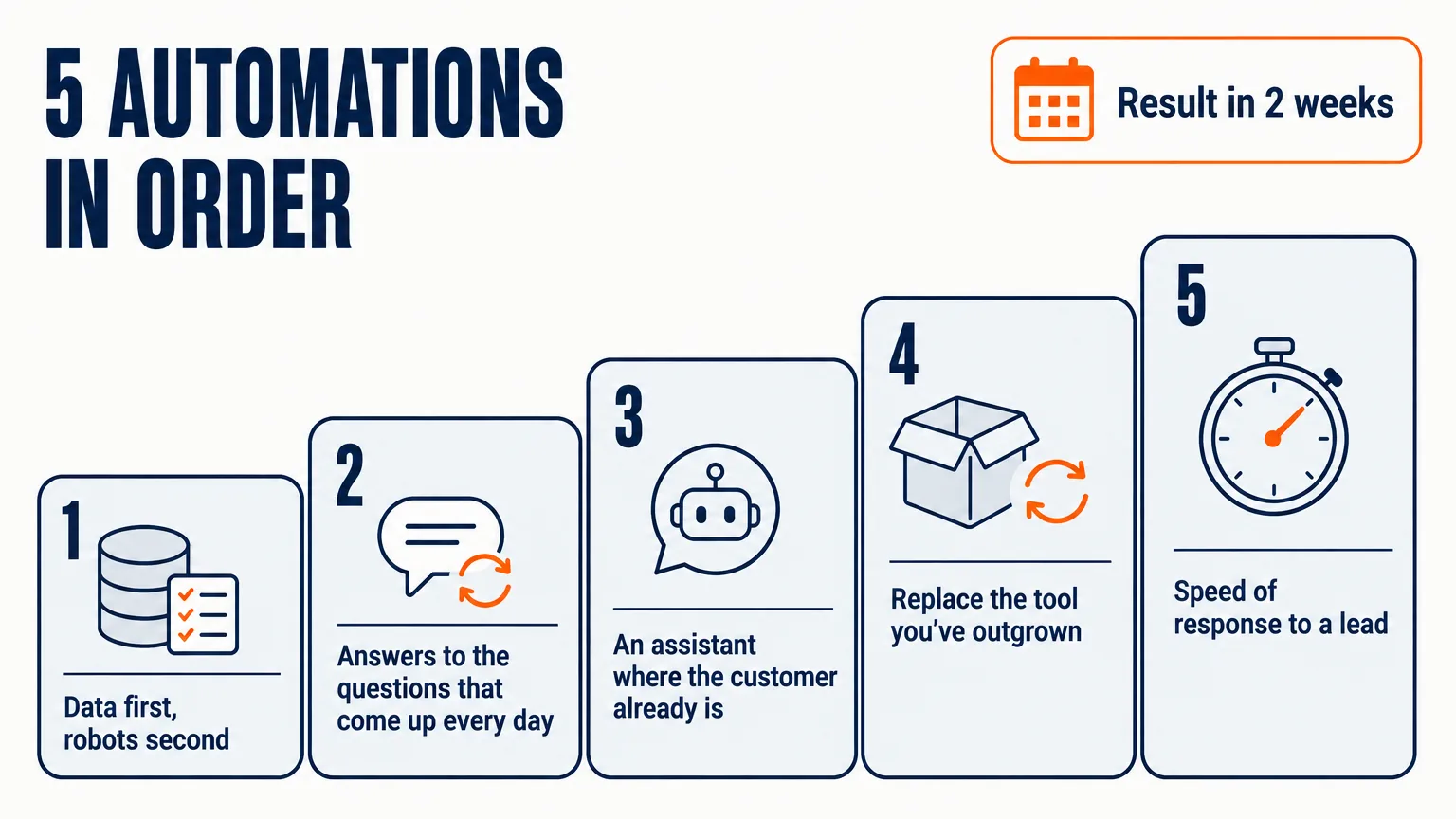
Step 1. Data first, robots second
The most boring item on the list, and the only one the other four don’t work without.
Back to that same pipeline. On the eleventh of June we moved 18,799 live leads into a new structure of nine stages — the rest of those 31,450 were archive and duplicates that weren’t worth moving. Not a single transfer error. On the thirteenth we deleted the duplicates and tagged 14,615 records by segment — converted, frozen, junk, active. Two days for the migration itself, and with the preparation, a week of attention from one person who understands the process, and zero lines of code.
The robots in this pipeline still aren’t set up. That’s sequencing, not forgetfulness: first a database where every record means exactly what it says, then everything else.
What you measure after two weeks: how many records in the database contradict themselves. There were many — now there are zero. It doesn’t sound like automation, and that’s fine. It’s the foundation everything else will stand on.
Step 2. Answers to the questions that come up every day
A manufacturing company, two plants, a network of five hundred dealers (we don’t disclose the name by agreement; the numbers are real). Every day the dealers asked the same things: availability, price, shipment status, payment terms. The managers opened the ERP and read the answer out loud.
We added up the routine: about 700,000 hryvnias a year of working time was spent on questions whose answer already sat in the database. Building an AI agent with read-only access to the ERP cost ≈110,000 hryvnias, and maintenance ≈18,000 a year. The net first-year effect came to ≈572,000 hryvnias, with payback in two to three months. Answer accuracy exceeded 95%. Managers laid off: none. They moved on to the non-routine requests they simply never used to get around to.
Two to three months is the fast end, not the norm. Typical payback is two to six months, and it’s better to plan closer to the upper bound. The full case breakdown, including the layers of protection against made-up answers, is on the Grow2.ai site.
Why this step is second and not first. Recurring questions are a ready-made, labeled dataset. You don’t have to guess what the user wants: they asked you about it three hundred times last month, and you have all three hundred requests saved.
Step 3. An assistant in the channel where the customer already is
The third automation doesn’t come down to “put a chatbot on the website.” A website is a room the customer walks into once every few months; a messaging app is the one they live in.
A large Ukrainian online clothing retailer with a chain of more than 30 physical stores launched an AI consultant at the end of March; we don’t disclose the name by agreement. The agent works in Instagram (about two-thirds of conversations), Viber, Telegram and the website chat, and writes the results to Bitrix24; it places the order itself, the order goes into 1C automatically, and the customer gets a payment link right in the chat. From April through July the agent handled 6,448 conversations. The most interesting thing in this data is the distribution, not the volume: 33% of inquiries arrive outside working hours, and 10% of all messages arrive between ten in the evening and eight in the morning. The median response time is 13 seconds; the ninetieth percentile is 31 seconds. June came to roughly €175 (≈$200 at the ECB rate of ≈€0.88 per dollar, July 2026) for 1,782 conversations, or ≈€0.10 (≈$0.11) per conversation. That is the unit in which the agent has to be compared with a manager: euros per conversation.
The channel split turned out to be different from how we were describing this project publicly back in the spring: Instagram 67.7%, Viber 17.6%, Telegram 11.9%, the website widget 2.9%. In our own texts Telegram and Viber were listed as the main channels for a long time. The June telemetry showed Instagram with two-thirds of all conversations, and the texts had to be rewritten.
The honest limit of this case: orders in the ERP are still placed by a person. The agent searches the catalog (including by photo), checks stock and sizes, shows order status, and logs the conversation in the CRM. Order placement is the next iteration, and it’s still in development. The case with telemetry describes the architecture in more detail.
What you measure after two weeks: the median response time and the share of inquiries that came in while everyone was asleep.
Step 4. Replace the tool you’ve outgrown
Five years ago this would have been bad advice. Today it’s my favorite step.
We were paying $45-50 a month for a management accounting SaaS. Not because it was good, but because nobody would have taken on moving our books going back to 2019 by hand. On the fifteenth of May I made the first commit to a platform of our own. On the twentieth of May it was running our live accounting. Five days.
Then came a core of eight phases, about two and a half weeks. In total: 326 commits, about 52,800 lines of TypeScript, 838 tests, a migration of 23,372 transactions covering 2019-2026, four legal entities, three users. The platform is called Finickly, and it’s the only case in this article where I can give a name: it’s our own.
The tool I built it with costs $200 a month — that’s the most expensive item in my stack, not the whole stack; the full bill and what it’s made up of are in the stack breakdown. More expensive than the SaaS we replaced, and that’s the whole moral. The saving here isn’t in the subscription at all. Our accounting is now described in our own logic, not in the logic of someone else’s product that we spent years bending our processes to fit. The technical breakdown covers the phases, the commits and the data migration.
Be careful with this step. It works when you know exactly how the process should run. If you don’t, your own tool will neatly lock your misunderstanding into code, and you’re the one who’ll have to live with it. My procedure for screening tools answers a related question: is this thing worth another two days at all.
Step 5. Speed of response to a lead
I don’t have this automation.
It’s fifth on the list and first on the list of things I’ll finally get done. So I offer it as a recommendation backed by other people’s data, not as a case of my own. I mark the difference between the two explicitly.
Harvard Business Review researchers analyzed 1.25 million leads at 29 B2C and 13 B2B companies. Firms that tried to make contact within an hour of receiving an inquiry were nearly seven times as likely to get the lead to a meaningful conversation with a decision maker as those that waited even one more hour. Compared with those that waited a day, the gap was more than sixtyfold. A parallel audit of 2,241 US companies showed the other side: 23% never responded to the test inquiry at all, and the average response time among those that did respond was 42 hours.
The original study came out in March 2011. Before you write it off as dated, run a cheaper check: submit an inquiry on your own website and time how many minutes pass before the first call.
Fifth step, not first, despite the obvious effect. The reason is the same: a fast robot on a dirty database means a fast mailing to the wrong people. Clean data first, then speed.
What’s not on this list and why
I’m regularly asked about three automations that sound appealing: a weekly digest for the team, brand mention monitoring, automated onboarding of a new customer in the first three days.
I don’t put them among the first. Not because they’re bad. Because I don’t have a single implementation I could point to with numbers, and recommending without numbers is exactly the blog advice I warned against at the start.
The “boring” financial processes stand apart: invoices, receivables, appointment reminders. They really do pay back first in many companies, and Auspex has covered them in detail in the article “Where to start automating in a small business: 5 boring processes”. That one answers the question “which processes.” This one answers the question “in what order.”
The order on one page
| Step | What you do | What you measure after two weeks | What backs it up |
|---|---|---|---|
| 1 | Clean the data and pipeline stages | Number of contradictory records | Auspex’s own pipeline: 31,450 leads, 23 stages → 9, zero transfer errors |
| 2 | Answers to recurring questions | Hours of routine per week | Dealer network: ≈572K UAH of effect in a year, payback in 2-3 months, 95%+ accuracy |
| 3 | An assistant in a messaging app | Median response time | E-commerce: 6,448 conversations, median 13 s, ≈€0.10 (≈$0.11) per conversation |
| 4 | Replacing a SaaS you’ve outgrown | Days to live use | Finickly: first commit → live accounting in 5 days |
| 5 | Speed of response to a lead | Minutes from inquiry to contact | HBR: nearly seven times as likely to qualify the lead when you respond within an hour |
The first three rows of the table are about what already works. The fourth is about what we built for ourselves. The fifth is about what I’ve owed myself for half a year now.
FAQ
Where do I start if the company has no CRM at all?
With a CRM, and that’s not a joke. Step one assumes the data lives somewhere. If it lives in the owner’s head and in three spreadsheets, there’s nothing to automate — first you need a place where the history of the customer relationship lives. An empty CRM filled in carefully from day one beats automation on top of spreadsheets.
How much does a first automation cost?
It depends on the step. Cleaning data costs time, not money: a week of attention from one person who understands the process. An agent for recurring questions starts at a few thousand euros of development, and this is where we at Grow2.ai offer a pilot from €1,800 with a contractual KPI. Payment is upfront, and at the thirty-day review a simple rule applies: if the agreed metric hasn’t moved, we refund the full amount. The format was chosen deliberately to fit that same two-week rule.
Can I skip the first step if the database “seems fine”?
Check it with one query: how many contacts share the same phone number or email. If the answer isn’t “zero,” the database isn’t fine, it just hasn’t offended anyone yet. We found 453 duplicates in the database of a company that works on other people’s CRMs for a living.
Why isn’t there an AI agent that sells on the list?
Because a sale is a non-routine action with a high cost of error, and first automations should be the opposite: routine, with a low cost of error, with the data already in place. An agent that answers questions about availability gets it wrong 5% of the time and ruins your day. An agent that sells gets it wrong 5% of the time and ruins a customer relationship. The difference between an assistant and a salesperson is covered separately: AI agent vs chatbot.
Two weeks to a result — is that realistic?
Realistic for the first number, not for full readiness. In two weeks you get a median response time, not a working support department. In two weeks you see how many duplicates are in the database, not a perfect pipeline. The point of the rule is to find out early that you’re doing the wrong thing, while it has cost you two weeks and not a quarter.
What if none of the five fits my business?
Then your process is either very specific or (more often) not yet described. The check is simple: ask an employee to write down everything they do in one working day, to the nearest fifteen minutes. Whatever repeats three times a day across three different people will be your first automation, even if it isn’t on my list.
Won’t this put people out of work?
In the dealer case nobody was laid off, and that’s not rhetoric — the managers moved on to requests they never used to get around to. Automating routine frees up hours, not positions. Positions get cut by other decisions, and in those AI is usually a convenient pretext, not the cause.
What’s next
The order I’ve described isn’t a universal law but the result of a few expensive mistakes and a few projects where everything came together. It answers the question “where to start” and doesn’t answer the question “what exactly is broken in your company.” That second question needs a look at your processes, and an article won’t help there.
If you want to walk through this list on your own data, get in touch, and we’ll start with which of the five steps comes first in your case and which one you can skip.
See also:
- How I Evaluate a New AI Tool in 20 Minutes — the screening procedure to run before you implement anything.
- My AI Stack 2026: What I Actually Use Every Day — the tools everything described above was built with.
- AI agent vs chatbot: difference, price, when to choose what — for when automation should act rather than answer.
- How to hire an AI consultant: a 12-question checklist — if you don’t feel like doing it yourself.
Published by Andrew Maryasov, AI consultant, founder of Auspex and Grow2.ai; implementations are run by Auspex (CRM) and Grow2.ai (AI agents).

A letter on AI — 2–3 emails a month
Personal essays on how AI changes the way we think and work: what I tried myself, what worked and what didn't. At the end, links to the best of what I read.
No spam. Unsubscribe in one click.