AI Agent Costs: Why the Bill Grows as Tokens Get Cheaper
I wrote that the cost of AI work always falls. Gemini 3.5 Flash tripled in price, and the same benchmark costs 5.5 times more. The mistake and the takeaways.
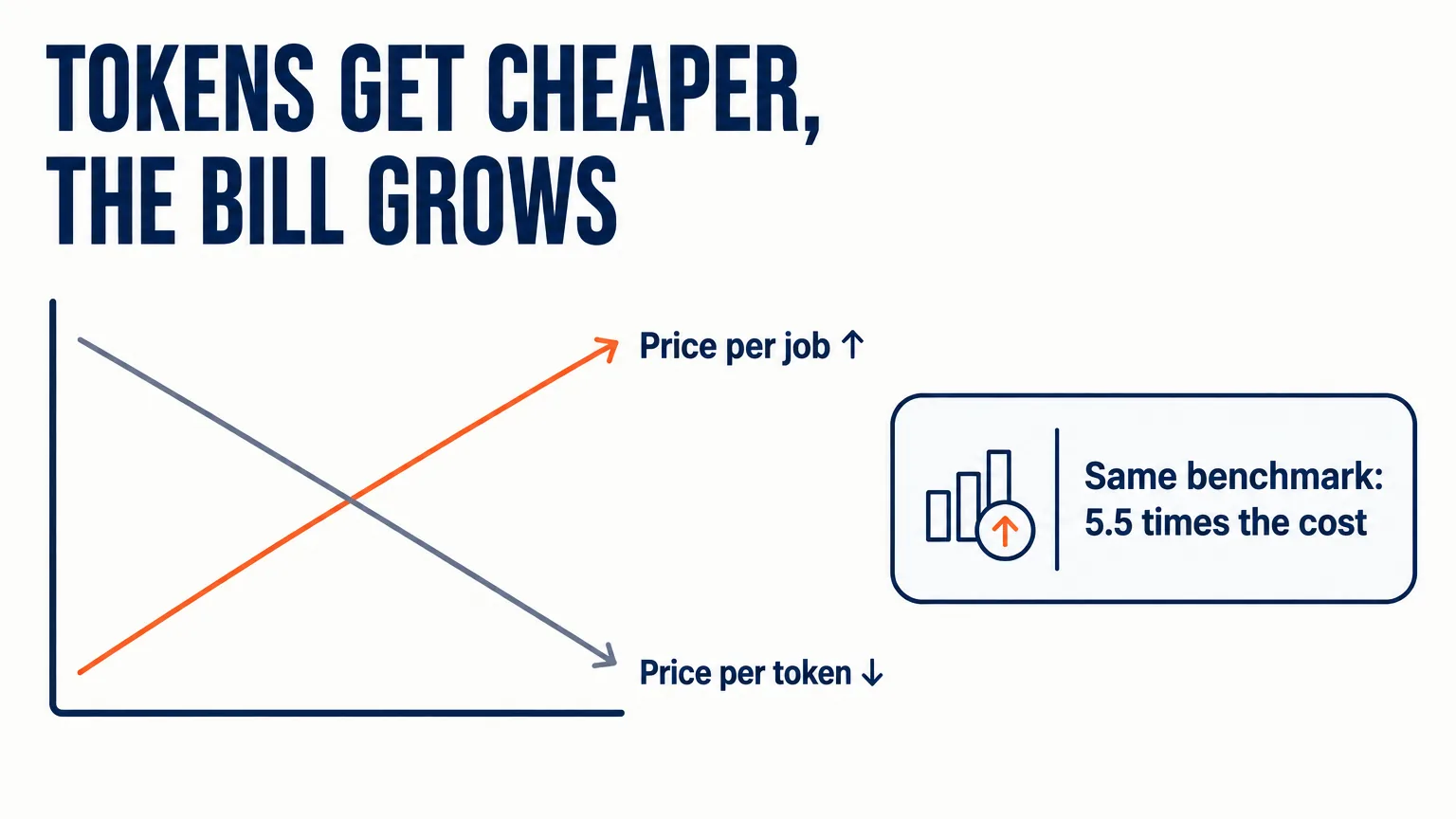
Andrew Maryasov, AI consultant. In February 2026 I claimed publicly that the price per unit of AI work always falls. In May Google released Gemini 3.5 Flash — and the same test suite its predecessor had run 5.5 times cheaper came to $1,552. Per token, Gemini 3.5 Flash is cheaper than Gemini 3.1 Pro. Per job, it is 75% more expensive. My mistake was treating those two quantities as one.
This is a dated breakdown of pricing dynamics, not an evergreen piece: all rates and version names are as of May 2026. As of October 2026, Google already routes requests for Gemini 3.5 Flash to Gemini 3.6 Flash, and 3.6 and 3.8 Flash cost $0.75/$3.75 per million tokens through the end of 2026 and $1.50/$7.50 from January 1, 2027. The mechanism that makes the bill grow while the price per token falls doesn’t depend on which models are current — but check the specific figures against the price list on the day you read this.
TL;DR (in 30 seconds)
- Price per token and price per job are different quantities, and the second doesn’t have to fall along with the first.
- Gemini 3.5 Flash costs $1.50/$9.00 per million tokens (input/output) versus $0.50/$3.00 for the model it replaced. Three times the price under the same “Flash” brand.
- On Artificial Analysis’s Intelligence Index run, the new Flash came out more expensive than Gemini 3.1 Pro — even though it’s cheaper per token.
- The cause isn’t the price list but the fact that a reasoning model spends iterations: thinking, verbosity, repeated steps, retries.
- The cost lever is the topology of the system, not a line in the price list. An agent that makes five calls where one would do costs more than any savings on the model.
I got caught out back in February
On 21 February 2026 I published a post about falling AI prices. It was prompted by a subscriber’s comment: “Andrew, $200 is a discounted price. Soon this subscription will cost $2,000. What will you do then?”
I answered with numbers. Stanford AI Index: the cost of GPT-3.5-level inference fell more than 280-fold in roughly a year and a half — from twenty dollars per million tokens in November 2022 to seven cents in October 2024. GPT-4 cost $30/$60 at launch; GPT-4o mini, sixteen months later, $0.15/$0.60. Then I brought out the Jevons paradox: when coal gets cheaper, people buy more of it, not less. And corporate spending on AI was growing precisely when the price per token collapsed — I’m deliberately not naming a specific percentage here, because I don’t have a primary source for it that I’m prepared to show.
And I added the sentence I’m now paying for: the price per unit of work is falling and will keep falling — that’s how every technology in history works.
I answered the subscriber with a chart, and three months later that same chart answered me.
What happened on 19 May
Gemini 3.5 Flash came out at Google I/O 2026. Straight into general availability, with no public preview. And then developers looked at the price list.
According to Google’s official price list as of late May 2026:
| Model | Input ($/1M) | Output ($/1M) |
|---|---|---|
| Gemini 3.1 Flash-Lite | $0.25 | $1.50 |
| Gemini 3 Flash | $0.50 | $3.00 |
| Gemini 3.5 Flash | $1.50 | $9.00 |
| Gemini 3.1 Pro | $2.00 | $12.00 |
The model positioned as the replacement for Gemini 3 Flash costs exactly three times as much as its predecessor. And it sits just a quarter below the Pro rate. For years the word “Flash” meant “the cheap but sensible tier” — now it means nothing specific (imagine 92-octane gasoline at the station suddenly costing as much as 98-octane, while the label on the pump hasn’t changed). The official price list confirmed it: $1.50 per million input tokens, $9.00 per million output tokens including thinking tokens, $0.15 for cached context.
The Batch put it in the headline of issue 355, dated 29 May: Gemini Flash Gets Pricey. The editors noted the wider context: Anthropic, OpenAI and Google have all raised the per-token price on their new models. The trend isn’t a one-off.
One release getting more expensive wouldn’t have bothered me in itself — prices move in both directions, and that’s normal.
Where exactly I was wrong
My thesis wasn’t “tokens are getting cheaper.” My thesis was “the unit of work is getting cheaper” — and that wording is exactly where I got caught.
Artificial Analysis runs every model through the same test suite — the Intelligence Index. It is literally the same job: the same tasks, the same volume. Here’s what it costs to run:
Gemini 3.5 Flash with thinking enabled came to $1,552. In Artificial Analysis’s own wording, that’s 5.5 times more than the Gemini 3 Flash run and 75% more than Gemini 3.1 Pro.
Read that again. The new Flash is cheaper than Pro per token ($1.50 versus $2.00) and at the same time three quarters more expensive than Pro per completed job. And against the model it replaced, the same job got 5.5 times more expensive. The Batch puts it bluntly: by Artificial Analysis’s measurement, Flash costs more to run than Gemini 3.1 Pro.
Both statements are true at once, and that possibility is exactly what my February model of the world didn’t allow for — back then I was genuinely convinced it was one and the same curve, just in different units.
An agent spends iterations, not tokens
The mechanism is simple once you see it. A token isn’t a unit of work. It’s a unit of billing. The unit of work is a solved task. Between the two sits the number of iterations the model spends before it gets to an answer.
A reasoning model thinks out loud, and every thinking token is billed as output. It’s verbose where its predecessor answered in one line. It second-guesses itself. In a complex chain it repeats a step that didn’t work out. A provider can cut the price per token in half — and still send a bigger bill if the model has started spending four times as many tokens on the same answer.
Then the architecture multiplies it. Picture an agent with ten sequential steps, each 95% reliable — a figure most teams would be happy with. The end-to-end reliability of that chain: 0.95¹⁰ ≈ 60%. Four runs out of ten will have to be repeated. Meanwhile your brain says “come on, it’s 95%, nearly perfect” — and the multiplication says otherwise. The bill for retries won’t show up on any vendor’s price list, but it will land on your card.
What’s more, a repeat costs more than the first run: the agent goes into its second lap with a bloated context. And without a separate verification step it doesn’t even know the first result was wrong — and pays the full rate for confident nonsense.
I’ve already written that tokens are a poor metric for an AI agent’s risk, and suggested measuring blast radius. It turns out tokens are just as poor a metric for cost. Two different roads led me to the same conclusion, and I managed not to notice it the first time.
Topology costs more than the model
The gap between the cheapest and the most expensive model in the table above is eightfold: from $0.25 per million input tokens for Flash-Lite to $2.00 for 3.1 Pro. The gap between a tidy sequential pipeline and a planner with a judge and consensus is an order of magnitude on the same task. Topology moves cost by orders of magnitude. Model choice moves it within a single order.
It follows that the order of work is the reverse of the intuitive one. First, audit the structure: how many calls the agent makes, how many of them are really needed, where a chain can be collapsed into one call with a sharper eval. Only then haggle over the model.
The most expensive architectural mistake isn’t even in the topology but in the aliases. If your config says gemini-flash with no version, your “cheap fallback option” may have tripled in price while you were reading this paragraph. A fallback policy written in early 2026 now leads into a different price category under the same name.
Klarna: the bill arrives in the wrong currency
The best-known example of cost being measured in the wrong place is Klarna.
Their AI assistant, running on OpenAI models, handled 2.3 million customer conversations in its first month, which was described as equivalent to the work of 700 support agents. Resolution time fell from eleven minutes to under two, and the company put the effect at roughly $40 million — all four numbers come from their own press release.
Then in May 2025 Sebastian Siemiatkowski, co-founder and CEO, started hiring people back. His wording: when cost becomes too predominant an evaluation factor, what you end up with is lower quality.
This case gets retold wrong all the time — and I nearly retold it the same way. A Klarna spokesperson later clarified that the CEO was talking about the quality of outsourced human agents, not AI. In the same piece, Forrester principal analyst Christina McAllister names cutting staff too sharply as the cause, not automation itself. Klarna didn’t “admit AI had failed” — it moved to a hybrid model and left the customer a guaranteed path to a human.
But the basic structure of the mistake is the same as mine with tokens. Klarna had a clean, measurable, falling metric: the cost of servicing a transaction, which according to their own report had fallen 40% since the first quarter of 2023. The metric was falling. The bill came in a different currency: repeat contacts, satisfaction, trust in the brand. I had a clean falling metric — the cost of a token. The bill came in iterations.
What you measure gets cheaper. What you don’t measure gets more expensive.
Does this cancel the Jevons paradox?
No. Jevons is alive and well: spending on AI is growing precisely because the unit got cheaper and the use cases multiplied. My February post described the macro picture correctly and gave the subscriber the right answer — $200 won’t turn into $2,000 for the same work.
The mistake was in the word “always.” I took a historical trend that rested on inference getting cheaper and extended it to a unit that is determined not by inference but by the model’s behavior and the shape of your system. The per-token price trend rests on hardware, quantization and competition, whereas the price per job depends on how many times your agent thinks before it answers. Two different curves, and they don’t have to move in the same direction.
What I changed in my own practice. I stopped looking at the price per million tokens as an indicator of cost. Instead I measure the cost of one successful task completion — with retries, with thinking tokens, with every step of the chain. Before evaluating a new tool, I now add the cost of iterations to the calculation, not just the cost of wiring it in. And I pin model versions in configs explicitly, because an alias is a blank check payable to the bearer.
The next time a vendor shows you a chart of the falling price per token, ask one question: and how many tokens does the same answer take now?
FAQ
Why is Gemini 3.5 Flash more expensive than Gemini 3.1 Pro if it’s cheaper per token?
Per token, the new Flash really is cheaper: $1.50 versus $2.00 on input. But on Artificial Analysis’s Intelligence Index run, with thinking enabled, it came to $1,552 — 75% more than Pro. The model spends far more tokens on the same work. According to Artificial Analysis, its output token usage is about the same as Gemini 3 Flash’s (73M vs. 72M), but its input token usage is much higher, because it takes more turns in agentic evaluations. That is what eats up the savings on the rate.
How much more expensive did Gemini Flash get, exactly?
Gemini 3.5 Flash costs $1.50 per million input tokens and $9.00 per million output tokens. The model it replaces, Gemini 3 Flash, cost $0.50 and $3.00 respectively. That’s exactly a threefold increase under the same “Flash” name.
What is “iteration price” as opposed to token price?
Token price is how much the provider charges per unit of text. Iteration price is how many tokens your system spends before it reaches an acceptable answer: the model’s thinking, repeated steps, retries after failed validation, coordination between agents. The second quantity shapes the bill, while the price list shows the first.
How do you actually bring down the cost of an AI agent?
Start with a topology audit: how many model calls the agent makes and how many of them are truly necessary. Collapsing an unnecessary chain into one call saves an order of magnitude. Choosing a cheaper model saves within a single order. That’s why structure gets optimized first and the model second.
Does this mean AI is getting more expensive overall?
No. The cost of inference at a fixed quality level has historically been falling, and that continues. What changed is that new models spend more tokens per answer, and agentic architectures multiply the number of calls. So a specific team’s specific bill can grow even as things get cheaper overall.
Why is it risky to write gemini-flash without a version in a config?
The “Flash” brand no longer guarantees a price tier. An alias without an explicit version can point to a model that costs three times as much as the one your fallback policy was written for. Pin the full model identifier.
Has the Jevons paradox stopped working?
It still works. Total spending on AI is growing precisely because the unit got cheaper and the use cases multiplied. The paradox describes the macro level. The mistake comes when people infer from it that the price of every specific task will fall too — it won’t.
Published by Andrew Maryasov, AI consultant, founder of Auspex and Grow2.ai; implementations are run by Auspex (CRM) and Grow2.ai (AI agents).
If you already have an agent running in production, calculate the cost of one successful task completion, not the cost of a million tokens. The difference between those two numbers is your real bill. How I take apart the topology and cost of agentic systems is on the advisory page. And if you run the numbers yourself, write and tell me what you got: I’m more interested in figures than in forecasts.
Sources:
- Gemini 3.5 Flash: everything you need to know — Artificial Analysis: $1,552 for the Intelligence Index run, 5.5 times more than Gemini 3 Flash and 75% more than Gemini 3.1 Pro
- Gemini 3.5 Flash pairs smarts with speed — The Batch, 29 May 2026
- Gemini API pricing — per-token rates
- AI Index Report 2025, chapter 1 — Stanford HAI: a drop from $20.00 to $0.07 per million tokens, November 2022 to October 2024
- Klarna AI assistant handles two-thirds of customer service chats in its first month — Klarna press release, 27 February 2024
- Klarna accelerates global momentum in Q1 2025 — transaction cost down 40% since Q1 2023
- Klarna is hiring humans again — Silicon Republic: the Klarna spokesperson’s clarification and a comment from Christina McAllister (Forrester)
- Klarna reinvests in human talent — Customer Experience Dive, May 2025

A letter on AI — 2–3 emails a month
Personal essays on how AI changes the way we think and work: what I tried myself, what worked and what didn't. At the end, links to the best of what I read.
No spam. Unsubscribe in one click.