A Personal AI Health Assistant: How I Gathered My Labs, Genetics, and Context into One Folder
How I gathered five years of lab results, a genetic test, and doctors' notes into one folder for AI — what it delivers in practice, and four rules to do no harm.
Andrew Maryasov, AI consultant. On client projects I do with data exactly what is described below on my own lab results: gather what is scattered into one place, give the model the full context instead of a fragment, and leave the final call to an expert. Same method here, only instead of a contract archive it is five years of my lab results, a genetic test, and doctors’ notes. The main thing upfront: not “AI instead of a doctor” but “AI before the doctor,” with four rules I follow strictly.
Important. This is not medical advice — it’s a personal account of organizing my own data. AI doesn’t diagnose, doesn’t prescribe treatment, and doesn’t replace a doctor. Make any health decisions — tests, supplements, dosages — together with your doctor.
TL;DR (in 30 seconds)
- Medical data lives scattered: different labs, different clinics, a genetic test sitting as a PDF in your inbox. At an appointment, the doctor sees — by my own rough estimate — something like five percent of your context.
- I gathered everything into one
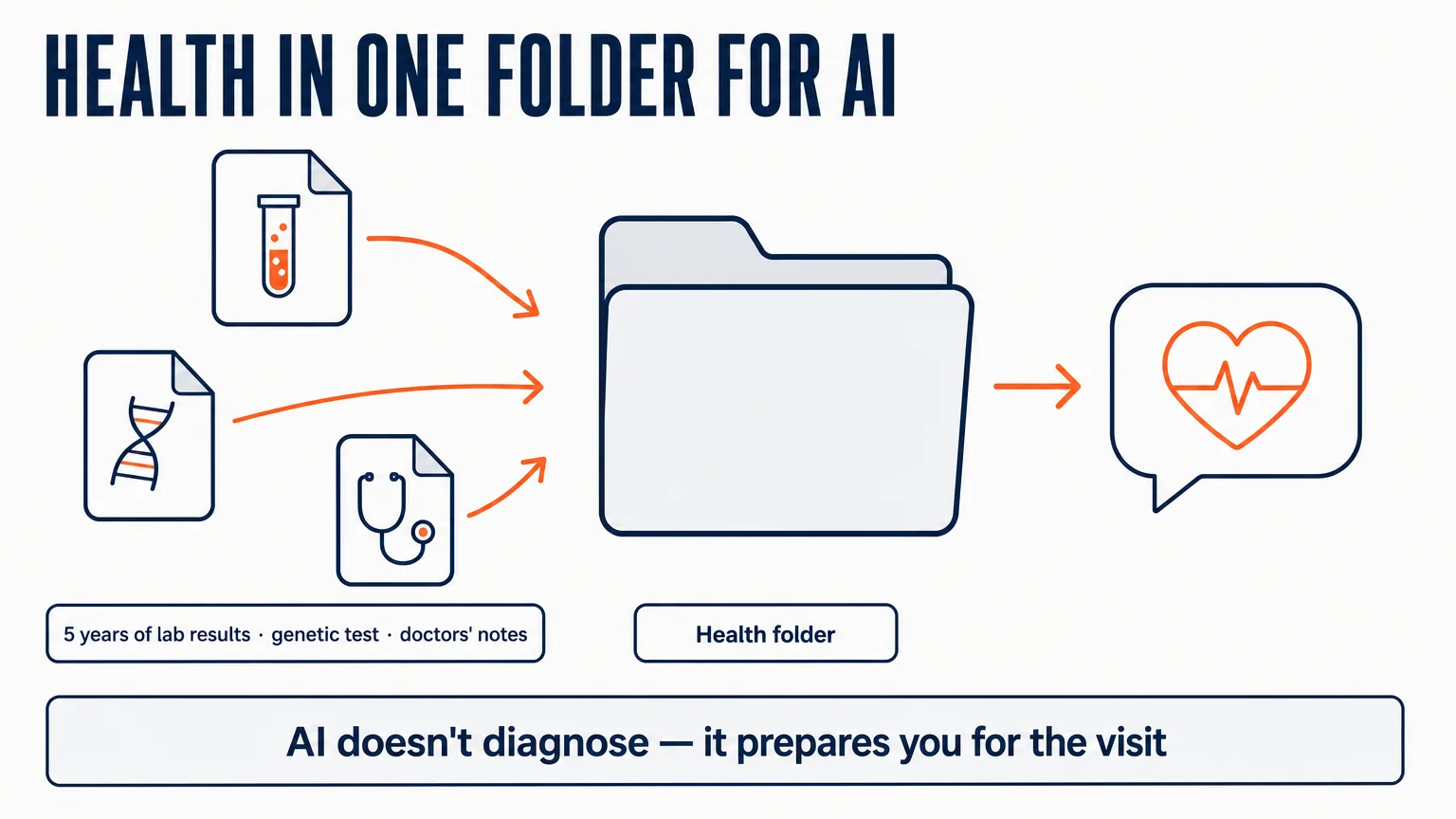
Healthfolder — five years of blood work, a tellmeGen genetic test, doctors’ notes, MRI and ultrasound scans — and loaded it into Claude Cowork. - In twenty minutes I got more practical context than in ten years of clinic visits: biomarker trends, six takeaways from my genetics, a ready-made list of questions for the doctor.
- AI doesn’t diagnose and doesn’t prescribe. It prepares you for the visit. The decision always happens in the doctor’s office.
Why your doctor sees only a sliver of your context
I’m 47. BMI 34. Vitamin D deficient for five years running. ALT rising three tests in a row. And off to the side, a forty-seven-page genetic test, of which I read the first ten pages — and put it away.
None of the three doctors who’ve treated me has ever seen all of this data together. My AI has.
The problem isn’t the doctors. Medical data is scattered by the very logic of the system: one lab in Kyiv, another in Las Palmas, a third somewhere else. The cardiologist’s report is at one clinic, the endocrinologist’s at another, the gastroenterologist’s at a third. Even you never read it all together — not once in all those years.
You come to the appointment — the doctor has fifteen minutes and one printout on the desk. They see maybe five percent of your context. And it’s not because the doctor is bad — the system is built that way.
What overrode my skepticism
Several stories have circulated in the press and on forums where somebody spent years going from doctor to doctor without a diagnosis, and a model reading the whole pile of data pointed at a direction a clinician later confirmed. I hold primary sources for none of them, so I am not going to retell them with diagnoses and dates: somebody else’s medical history without a citation is an anecdote, not evidence.
The mechanism in them is not magic, though, and you can check it on your own data. AI simply reads all the documents at once and sees connections that a doctor physically cannot spot in a short appointment. What follows is how I did it for myself.
How I set this up for myself: one Health folder
In my Obsidian vault — the same one my whole AI stack is built around — there’s a Health folder with four subfolders:
Bloodwork/— five years of blood tests, three labs, organized by date;Genetics/— the tellmeGen report (a consumer genetic test I ordered myself, with no referral): 47 pages, six separate reports;Visits/— doctors’ conclusions, with dates;Imaging/— MRI, ultrasound, X-rays.
Then I loaded all of it into Claude Cowork — it works with files and spreadsheets directly — and started asking specific questions:
- Show me the ALT, glucose, and uric acid trends over five years. Which ones are worrying?
- What does my genetic profile change about my training and supplements?
- Draft five specific questions for the gastroenterologist for my next visit.
Twenty minutes of that gave me more practical context about my own health than the past ten years of walking into clinics.
The genetic test: from 47 pages to six takeaways
I took the test in the spring of 2026. When the PDF arrived, I read the first ten pages and set it aside: too much information, no answer to “so what do I do with this day to day.”
But when I gave that PDF to AI together with my lab results and training plan, 47 pages turned into six practical takeaways.
Once more, before the table. What follows is not advice and not a prescription — it is the list of topics I brought to my own doctor. Vitamin forms, dosages and anything in the last row are decided by a clinician, not by a model and not by this article.
| What the test showed | What it changes in practice |
|---|---|
| Fast-twitch muscle fibers dominate — a sprinter profile | Four sets of 6–8 reps with heavy weight work better than 3×15 |
| High risk of tendinopathy in the arm tendons | Overhead press stays light, especially for the first eight weeks; warm-up is non-negotiable |
| Low bone density | Strength training is osteoporosis prevention at sixty; cardio doesn’t do that job |
| Two mutations in methylation genes | Standard forms of folic acid and B12 absorb poorly — I need the active forms |
| Slow metabolism of one class of antibiotics | A standard dose could be toxic — a topic to raise with my doctor |
| Hereditary risks for certain diseases | I know what to be prepared for and what to discuss with my doctor |
I learned about my muscle fiber type from the test — before that, the variable simply did not exist in my training. And the supplements question went from “to take or not to take” to “which exact form to take.” Without the genetics, I’d have been taking the wrong one and wondering why the numbers weren’t moving.
The conclusion is simple: a genetic test explains why your body responds the way it does, rather than adding one more number. But a 47-page PDF on its own helps no one — your doctor won’t read it, that’s not their job. It helps when AI reads it together with your lab results and the context of your life.
Four rules to do no harm
1. AI prepares you for the visit — it doesn’t replace the doctor. I walk into the gastroenterologist’s office with “my ALT went from 50 to 77 in a year, glucose is 108 — let’s discuss a plan” instead of “something’s bothering my liver.”
2. AI doesn’t prescribe. If it suggested a supplement, that’s a topic for the doctor, not for the pharmacy. I started taking D3 with K2 after a consultation with an endocrinologist, and agreed on the dosage with my family doctor. AI proposes a direction — the decision is made in the doctor’s office.
3. Verify the references. In Walters and Wilder’s study (Scientific Reports, 2023), across 636 model-generated bibliographic references, 18% of GPT-4’s were fabricated — roughly one in six. Models have grown up since, but the rule stands: when AI says “studies show” — demand a DOI or a PubMed ID. No reference, no fact.
4. AI can’t see you physically. It won’t hear how you breathe, won’t see the color of your skin, won’t palpate your liver. A doctor can. AI is the preparation. The exam happens in the office. The diagnosis comes from the doctor.
What this delivers in practice
- Five years of biomarker trends on a single chart, instead of dozens of PDFs from different labs.
- I understand which genetic-test findings actually affect daily decisions — from vitamin forms to the weight on the bar.
- I walk into appointments with specific questions and a complete dataset, not a vague “something feels off.”
- I see connections between markers instead of isolated numbers from different years.
Where to start this week
If you have at least three lab reports from the past five years, and somewhere in your inbox there’s a genetic test you’ve never re-read:
- Create one
Healthfolder — in Google Drive, Obsidian, wherever works for you. - Drop in everything you can find: lab results, genetics, doctors’ notes, MRIs.
- Load the folder into Claude or ChatGPT and ask it to find the five-year trends and draft questions for your doctor.
- Go to the appointment with those questions — not with a complaint.
The doctor will still have fifteen minutes per visit. The only difference is what lands on the desk during those fifteen minutes: a single printout — or a condensed digest of your entire medical history. The most interesting question is what happens to medicine when every other patient shows up with that kind of context, instead of one in a hundred. The system isn’t ready for that yet. Patients very much are.
Important. This is not medical advice — it’s a personal account of organizing my own data. AI doesn’t diagnose, doesn’t prescribe treatment, and doesn’t replace a doctor. Make any health decisions — tests, supplements, dosages — together with your doctor.

A letter on AI — 2–3 emails a month
Personal essays on how AI changes the way we think and work: what I tried myself, what worked and what didn't. At the end, links to the best of what I read.
No spam. Unsubscribe in one click.