Claude as a Travel Guide: Barcelona in 40 Minutes and a Prompt That Works in Any City
How Claude with MCP planned Barcelona in 40 minutes, where it failed — and a ready-to-use prompt that turns any AI into a personal travel guide.
Andrew Maryasov, AI consultant. This trip is a small test of the very principle we build business AI agents on: described context beats a ready-made template, and five lines about your own quirks are worth more than two hundred pages written for the average user. Testing it on yourself is convenient, so I plan trips with the same tools I use for work projects. After my April posts about Barcelona with Claude, 11 people asked for a guide for their own cities — so here are both things at once: the experience and the tool.
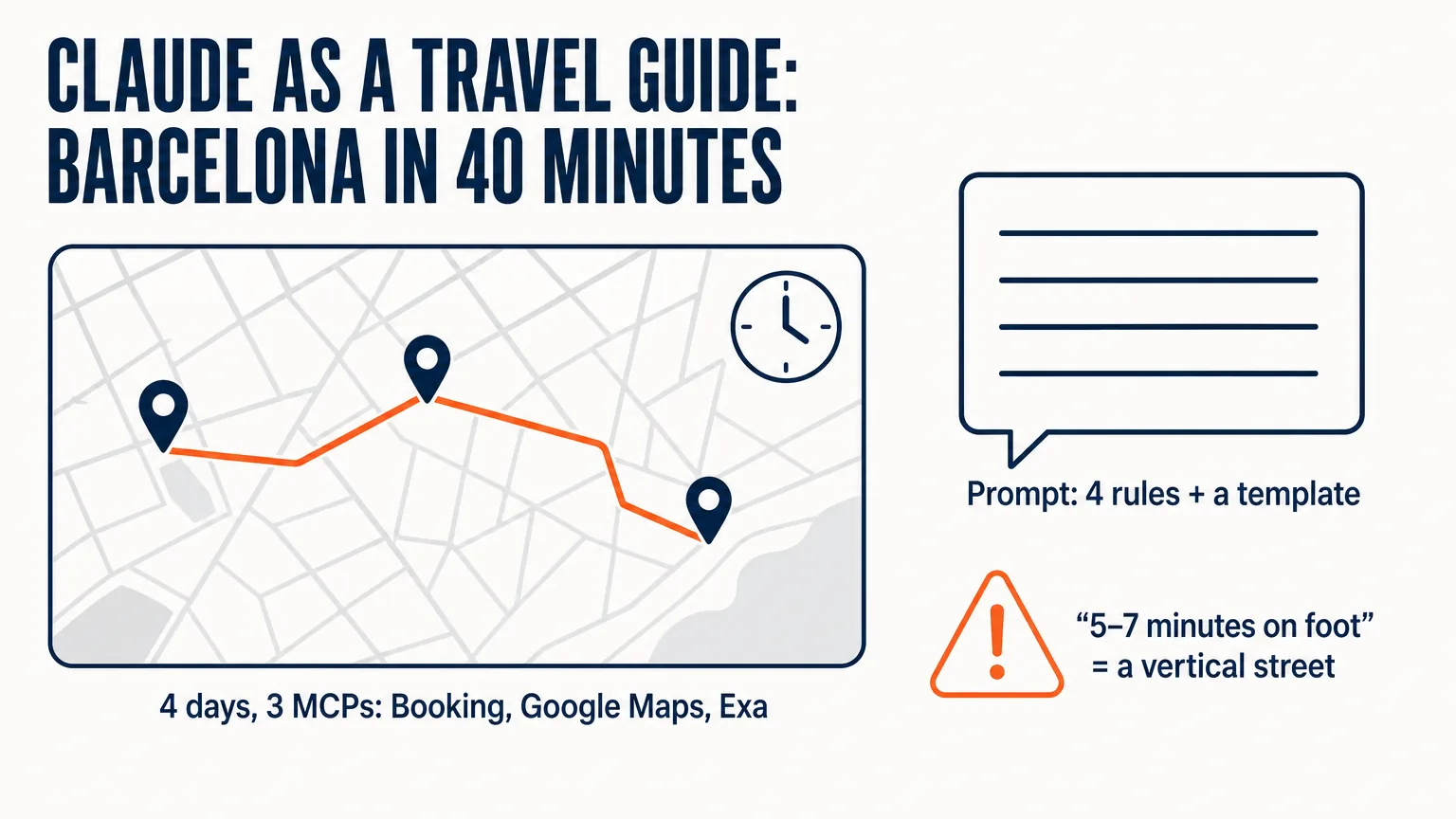
TL;DR (in 30 seconds)
- Claude with three MCPs (Booking, Google Maps, Exa) planned my 4 days in Barcelona in 40 minutes — shaded walking routes, restaurants without paella, two hotels around an early-morning flight.
- AI is not an oracle. At Park Güell, “a 5–7 minute walk” turned out to be a vertical street made of stairs. The last 100 meters you walk yourself.
- Below is a ready-to-use prompt: four rules and a template, tested on Paris, Amsterdam, and Rome. Works for free in ChatGPT, Claude, and Gemini.
- A guide for everyone is a guide for no one. The “average tourist” is a statistical fiction — which is exactly why the standardized PDF guidebook industry is losing its point.
Planning “the old way”: YouTube, TripAdvisor, and 40,000 hotels
“Which restaurants? Where to stay? What to see?” — and off you go: YouTube first, then TripAdvisor, then Booking with 40,000 hotels, of which 39,998 don’t fit. Then Google Maps with pins you forget about within a week. The result: three days in Barcelona boil down to La Rambla and the crowd in front of the Sagrada Família.
But there’s another way — one that takes 40 minutes.
Barcelona in 40 minutes: Claude with MCP as a personal guide
In April I was planning Barcelona. I opened Claude Desktop with MCP servers connected — Booking, Google Maps, and Exa web search (I covered my full everyday setup in “My AI Stack 2026”). And dumped all my quirks into the chat:
Going for 4 days. I want to avoid crowds. Plot walking routes along shaded streets — it’s going to be hot. Mediterranean food, but no paella and no jamón — I’m in Spain for other things. A hotel in a quiet neighborhood but with decent transport connections. And the last day is an early-morning flight, so the final night should be closer to the airport.
What I got back in 40 minutes:
- Tibidabo at 10 a.m. — a panorama of Barcelona from the mountain before the tourist buses arrive. Claude checked the opening hours and planned the route from my hotel so I’d arrive 20 minutes before opening — no line.
- Castell de Montjuïc — a hilltop fort with a completely different angle on the city and the port. The way up runs through the botanical garden, in the shade, instead of sun-baked asphalt.
- Mediterranean restaurants in Gràcia and El Born, with grilled dishes, fish, and fresh vegetables on the menu — while the paella and jamón stayed behind in the tourist quarters.
- Two hotels. The first three nights — a quiet neighborhood with a metro station five minutes away. The last night — a separate hotel near the airport, because the flight was at 7:30. Claude suggested it on its own: “it makes more sense to split into two locations, you’ll save an hour of sleep and your nerves.”
This isn’t “chatting about a trip.” It’s a personal guide that reads the internet, the maps, and the bookings all at once — tuned to my quirks. Setup takes about 15 minutes, once.
Where Claude let me down: the stairs of Park Güell
Park Güell. Claude plotted the route to the entrance — 600 meters, “roughly a 5–7 minute walk.” I get there — and those 600 meters turn out to be a vertical street made of stairs.
Twenty-eight degrees Celsius in the sun. By the fifteenth step my shirt was stuck to my back. Around the fortieth I stopped to drink water. At the sixtieth I started counting them — simply because there was nothing else left to do. At the eightieth I understood: nobody up top is going to throw me a rope, I have to climb it myself.
Claude didn’t warn me because maps don’t mark gradient explicitly, and it never cross-checked via street view. And that’s the most valuable takeaway of the trip: AI is powerful, but it’s not all-knowing. Use it as a well-read older friend, not as an oracle. It will save you two hours of googling — but the last 100 meters you’ll still walk yourself. Literally.
The “average tourist” is a statistical fiction
The standardized travel-guide industry — paid PDFs, TripAdvisor Top 10s, printed guidebooks — was written for the average tourist. And the average tourist doesn’t exist.
A real tourist is me, with my dislike of crowds. Or you, with your love of the sea. Or a friend with a dog, looking for a hotel with a park nearby. Or a friend with a child in a stroller, for whom it’s critical not to haul it up and down three flights of stairs to the metro.
A guide for everyone is a guide for no one.
“Why would you even use AI to plan a trip?” a friend asked.
“Because Google knows the average tourist. Claude knows me.”
The three-city test: Paris, Amsterdam, Rome
This is raw model output that I have not verified. What follows is what the AI produced for three requests, as an illustration of how deeply it works a task, not as a reference on prices and rules. That is exactly why the prompt below demands a URL for every fact: the reader checks before travelling rather than trusting a retelling in an article. I removed the specific amounts on purpose — they go stale faster than this text gets updated.
Within a week of the Barcelona post, 11 people wrote: “make a guide like that for my city.” I decided to hand out a fishing rod instead of fish: I reviewed 8 popular ready-made prompts from around the web — not one of them forces the AI to search the internet and attach URLs to its facts. So I built my own and ran it through Gemini on three cities.
Paris, four days in summer, food + photography. The AI noticed on its own that the Tour de France finale would shut down the city center on the Sunday — and rewrote the day. It found the raised per-night city tax, the croissant that won the national competition at La Maison d’Isabelle, and three photo spots that aren’t in the guidebooks: Villa Léandre, Rue de l’Université, Bibliothèque Richelieu.
Amsterdam, three days in September, photography + architecture. On Prinsjesdag the king is in The Hague, but the trains out of Amsterdam are packed, so the AI restructured day one. It warned that accommodation got more expensive: from 1 January 2026 Dutch VAT on overnight stays moved from the reduced 9% to the standard 21% (official guidance), on top of the city tourist tax. The city is also cashless even in public toilets. And it pointed to free architectural gems: Sluishuis, which “hovers” above the water, and The Valley, the much-awarded tower in Zuidas.
Rome, three days in summer, budget + food. The AI warned that entry to the lower area of the Trevi Fountain has become paid and capped by daily headcount, and that the Pantheon has moved to named tickets with a passport check at the door. Both rules need checking against the official sites before you travel — which is exactly why they appear here without amounts and without dates. And beyond that — Galleria Sciarra, a lavish Art Nouveau courtyard two minutes from Trevi; the keyhole of the Knights of Malta on the Aventine, through which you can see three states at once; and 2,500 free nasoni drinking fountains.
Four rules of a working prompt
The difference between a prompt that works and a prompt full of fluff comes down to four things:
- Force the AI to search the internet. Otherwise you’ll get 2023 prices.
- Give it specifics about yourself: dates, budget, pace, interests, options like “with kids” or “food-focused.”
- Demand a URL for every fact. Otherwise the model will confidently invent opening hours.
- Ban the fluff. Only what / where / how much / when / why. And secrets from locals, not TripAdvisor.
The ready-to-use prompt: copy it and plug in your details
You are an experienced travel advisor. Create a personalized guide for a trip.

HARD RULES (breaking them = a bad result):
1. Run AT LEAST 8 web searches BEFORE writing the guide. Cover: weather for the dates, tourist tax/city fees, transport and travel passes, major sights (prices+hours), food/restaurants, local events on the dates, travel advisories, new access rules.
2. Every fact involving a price, hours, or a rule — with a source URL in parentheses. NO URL = don't include the fact. Better less, but all of it verified.
3. Sources must be fresh (no older than 12 months). If older — write "⚠️ information from [date], double-check before the trip".
4. Current-year accuracy is mandatory: verify you're not using prices/rules from past years. In 2024–2026 many places introduced paid entry (Pantheon, Trevi, quotas) — check.
5. No generic phrases. Only: what · where · how much · when · why · [source].
6. Prefer OFFICIAL sources (city, museum, and transport company websites), not aggregators.

INPUT:
- City: [CITY]
- Dates: [DATES]
- Who's going: [solo / couple / with kids / group + ages]
- Budget per person per day (excluding lodging): [€X]
- Pace: [relaxed / moderate / packed]
- Interests: [food / architecture / nature / art / history / photography / nightlife]
- Constraints: [none / allergies / mobility / language]

OPTIONS (keep the ones you need, delete the rest):
[WITH KIDS: ages (specify). Routes matched to stamina, playgrounds, lunch at 12:00.]
[BUDGET MODE: stick to the budget. 2+ free activities per day, lunches under €12.]
[FOOD TOUR: 15 dishes with price and place, 3 markets, 1 cooking class, seasonal produce.]
[PHOTO/VISUAL: time of day for the light, angles, 5 spots without the camera crowds.]
[ROMANCE: 3 dinners with a view, 2 sunset spots without crowds, spa, one activity for two.]
[MOBILITY: no stairs, routes with elevators, accessible transport.]
[LAYOVER (6–12 hours): what to fit in without luggage, luggage storage.]

RESPONSE STRUCTURE:
## Context — weather, seasonality, events, tourist tax, 3 must-knows
## Day-by-day plan — 09:00, 12:30, 14:00, 19:00, evening (every item with address, price, hours, source)
## Local secrets — 5 places locals actually go
## Practicalities — transport, money, SIM, 10 phrases, 5 tourist mistakes
## Budget summary — breakdown + check against the stated budget

SELF-CHECK before answering:
☐ Does every price have a URL?
☐ Do all opening hours have a URL?
☐ Is the tourist tax mentioned?
☐ Are the new 2024–2026 rules accounted for?
☐ Is the budget checked?
☐ No fluff — specifics only?
☐ Are the sources official?
If even one box is empty — rework it first, then answer.
Works for free in ChatGPT, Claude, and Gemini — I tested it on three cities and three travel profiles.
The last 100 meters
If you’re still buying travel PDFs, you’re paying for something that’s already free today in any LLM with a couple of connected tools. This isn’t a one-quarter trend — it already works for a concrete Barcelona, Paris, and Rome.
The value has shifted from whoever collected the facts to whoever described their own context precisely — exactly as in the Grow2.ai work projects I opened this text with.
I still have TripAdvisor’s Top 10 Barcelona in my bookmarks — an article saved back in 2018. I never opened it once during the whole trip, but I can’t bring myself to delete it — it feels like throwing away an old crutch. Makes me wonder how many of those “crutches” are still sitting in our bookmarks — and which one becomes useless next.

A letter on AI — 2–3 emails a month
Personal essays on how AI changes the way we think and work: what I tried myself, what worked and what didn't. At the end, links to the best of what I read.
No spam. Unsubscribe in one click.